
Infrastructure & Career Analysis
Networking’s Second Golden Age: CCIE Skills for AI Infrastructure
Explore how CCIE-level skills, hands-on practice and adjacent infrastructure knowledge connect to AI data center careers, including paths for veterans.
Can advanced networking skills remain valuable in the AI era? Yes: AI workloads still need dependable infrastructure. The strongest career proposition combines certification, real hands-on experience and adjacent infrastructure skills. CCIE-level knowledge can provide a foundation for moving toward AI and data center networking; it does not by itself qualify someone to operate a specialized GPU fabric.
“Second golden age” is an editorial description of this opportunity, not an official industry term or a forecast of guaranteed hiring. AI can automate parts of network operations while creating different demands on the networks supporting it. The useful question is which technical responsibilities you can learn to carry, verify and explain.
AI infrastructure is more than GPUs
An AI infrastructure network connects accelerators, servers, storage, management systems and users. Distributed training can involve substantial east-west traffic: communication among systems inside a data center. Traffic entering or leaving the environment is commonly described as north-south traffic. Training, inference and storage workloads have different communication patterns; no single topology fits every deployment.
NVIDIA’s Spectrum-X documentation describes an Ethernet platform connecting AI compute fabrics. That is concrete evidence that AI systems depend on networking, not evidence that every organization needs the same product or that every network job is growing.
The engineering work includes:
- Switching, routing and high-speed interconnects: choose paths and validate how the fabric moves traffic.
- Capacity planning and traffic engineering: understand bandwidth demand, oversubscription, congestion and workload placement.
- High availability: design redundancy and test recovery when a link, device or service fails.
- Observability and troubleshooting: correlate interface counters, telemetry, logs and application symptoms.
- Security and segmentation: separate management, workload and storage access while applying appropriate identity and authorization controls.
- Automation and operations: use reviewed changes, repeatable validation and recovery procedures across the infrastructure lifecycle.
For example, a slow distributed job may be a network problem, a storage problem or a compute problem. A useful investigation first establishes a baseline, checks link health and traffic distribution, and compares timing with storage and server telemetry. Changing routing before establishing evidence can add another fault. This is an illustrative diagnostic workflow, not a report of a LaneCert customer incident.
Why a second golden age is a useful way to think about networking
Cloud services abstract many routine infrastructure tasks. They do not remove physical connectivity or the need to design reliable hybrid environments. AI infrastructure brings bandwidth, latency variation, congestion, resilient fabrics and data center scaling into sharper operational focus.
This creates a plausible opportunity for engineers who understand both protocol behavior and the systems using the network. It can also raise the bar: an engineer may need to discuss server interfaces, storage traffic, Linux tools and security boundaries with other teams. The opportunity is a change in the skills mix, not a promise that all traditional networking tasks will expand.
AI for networking uses AI to assist operations. Networking for AI builds and operates connectivity for AI workloads. They overlap, but learning an AI operations tool is different from diagnosing a fabric that carries distributed training traffic.
The infrastructure build-out is already underway, while individual technologies and employers’ staffing needs continue to develop. Early projects can offer valuable experience with design trade-offs and operating failures. As deployments mature, expectations may rise and entry-level roles may become more competitive. There is no universal deadline: choose a pathway that builds transferable skills rather than relying on a “last chance” hiring story.
Where CCIE-level skills transfer, and where more study is needed
Cisco’s CCIE Enterprise Infrastructure overview covers advanced enterprise infrastructure, security, automation and practical operations. Those abilities can support a move into more specialized infrastructure work.
| Existing networking strength | Application to AI infrastructure | Additional learning to validate |
|---|---|---|
| Routing, switching and failure analysis | Reachability and recovery across a data center fabric | Leaf-spine design, BGP underlays and EVPN/VXLAN where used |
| Network assurance and troubleshooting | Distinguishing congestion, packet loss and endpoint problems | Workload-aware telemetry, Linux and server-interface diagnostics |
| Security and infrastructure services | Protecting management and workload access | Identity controls, hybrid cloud policy and storage/server dependencies |
| Automation and change discipline | Consistent deployment and validation | Python, APIs, version control and tested rollback workflows |
These are examples of transferable foundations, not a claim that every listed topic belongs to the current CCIE Enterprise exam. Some AI fabrics use Ethernet with RDMA over Converged Ethernet (RoCE); others use InfiniBand. Specialized congestion control and transport tuning require additional platform-specific learning.
Cisco’s 300-640 DCAI exam separately addresses AI infrastructure across networking, compute, storage and orchestration. CCIE Enterprise preparation and AI cluster specialization should therefore be treated as related but distinct learning goals.
Certification plus real experience is stronger than a certificate alone
Certification provides a structured knowledge framework and a way to demonstrate technical breadth. Employers also need evidence that an engineer can configure real equipment, understand a physical topology, diagnose routing and switching failures, work under pressure and document changes.
A practical portfolio can include a topology diagram, sanitized configurations, baseline measurements, a controlled failure test and a recovery record. Explain what changed, why it worked and what remains uncertain. Avoid publishing proprietary configurations, credentials or any classified information.
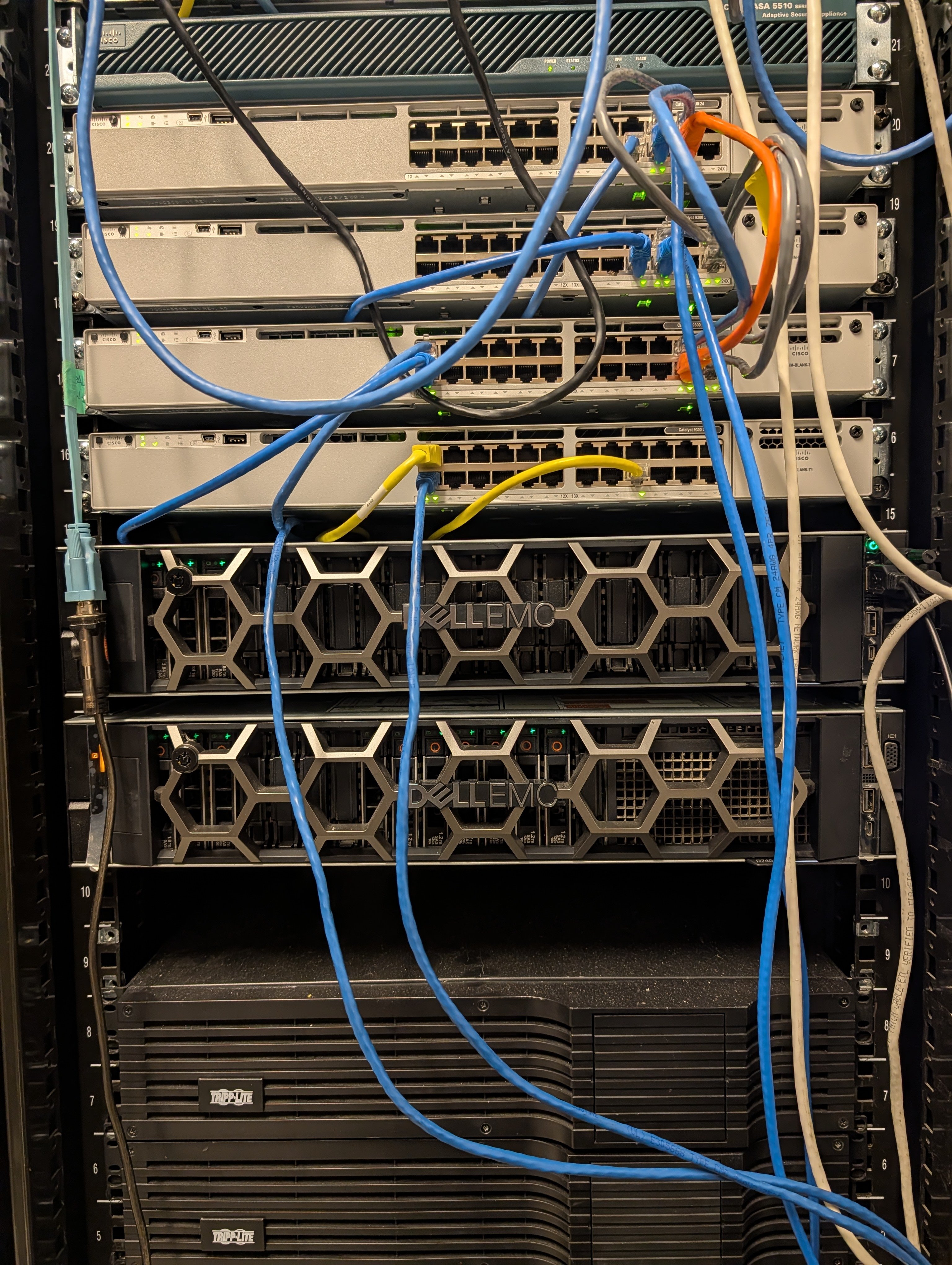
LaneCert combines certification preparation with real networking and infrastructure equipment practice. Its real-lab page shows the physical equipment used in training; the photo on this article is LaneCert lab equipment, not an AI production cluster. The faculty profiles identify Xuan Liu, Co-Founder and Lead Instructor, with documented enterprise networking, automation and data center architecture experience.
Current LaneCert paths focus on Enterprise Infrastructure, with NA → NP → IE progression, and Security subject to consultation. The programs page separately identifies development concepts, including Data Center Liquid Cooling. A development concept is not an available AI infrastructure course; this roadmap does not claim that LaneCert currently teaches every adjacent skill listed here.
Veterans, security clearance and networking careers
Some veterans bring mission-critical operations experience, work in regulated environments, prior cleared-environment experience, or active or recently active clearance history. Many veterans do not have a clearance. These are individual circumstances, not attributes of veteran status itself.
For certain DoD contractors, federal contractors, cleared data centers and secure networking positions, verified clearance eligibility or the ability to meet the position’s clearance requirements can be a meaningful hiring advantage. Prior clearance history does not guarantee current access, transferability or hiring. Confirm requirements with the employer’s security office; do not assume a universal post-service validity period.
DCSA explains that clearance processing is tied to an employing organization’s position requirements. A security clearance is granted by the U.S. government through the appropriate security process; a training provider does not issue or guarantee a clearance.
VA education benefits are separate. VA administers education benefit programs; it does not issue security clearances. The VA education resource concerns benefits, not cleared access. Confirm benefit eligibility, program approval and attendance arrangements separately through the LaneCert veteran pathway and official channels.
For the right role, military experience + applicable, verified clearance history + advanced networking skills + hands-on infrastructure practice can form a competitive profile. That is a career-planning inference, not an assurance of employment. Describe unclassified achievements and operational responsibilities; never include protected mission details in a portfolio or inquiry.
Career directions to investigate
Job titles vary between employers and are not a standardized ladder. Compare actual responsibilities and required experience, not just titles:
- Network Engineer and Senior Network Engineer
- Data Center Network Engineer and Network Architect
- Infrastructure Engineer and Data Center Infrastructure Engineer
- Network Security Engineer
- AI Infrastructure Network Engineer
- Cleared Network Engineer
- Defense or Federal Infrastructure Engineer
An “AI network engineer” may work on a compute fabric at one employer and enterprise connectivity at another. Cleared roles add position-specific security requirements; a Cisco certification does not satisfy them automatically. This article makes no salary or hiring-volume prediction. For a separate occupational overview, see networking career categories and BLS references.
A four-stage skills roadmap
- Networking foundations: CCNA-level concepts. Learn addressing, switching, routing and packet flow. Deliver a small working topology and explain a connectivity fault. See the CCNA foundation stage.
- Enterprise operations: CCNP-level skills. Deepen routing, switching, resilient design and systematic troubleshooting. Demonstrate a controlled failure and recovery. See CCNP Enterprise.
- Architecture and advanced troubleshooting: CCIE-level depth. Practice design trade-offs, operational verification and automation under constraints. Document both successful changes and rollback. Explore CCIE Enterprise Infrastructure.
- Add adjacent infrastructure skills. Build Linux, Python/API, data center networking, virtualization, cloud, security, observability and server fundamentals. Practice correlating a network symptom with a host or workload symptom; use platform-specific documentation before working on specialized AI fabrics.
Security belongs throughout the roadmap. NIST SP 800-207 treats zero trust as resource-focused access control rather than trust based simply on network location. Segmentation alone does not establish zero trust.
The aim is evidence of engineering judgment: certification + hands-on experience + adjacent skills. Use the current program list and contact page to discuss the part LaneCert can support for your background.
Frequently asked questions
Is CCIE still valuable in the AI era?
It can be valuable as evidence of advanced networking knowledge and practical depth. Its relevance depends on the role and on your ability to apply that knowledge. AI data center work also requires additional compute, storage and platform-specific skills.
Will AI replace network engineers?
AI can assist configuration, diagnosis and documentation. That does not establish that engineering responsibility disappears. Engineers still need to validate changes, investigate failures and coordinate reliability and security decisions; the mix of tasks may change.
What networking skills are useful for AI data centers?
Routing, switching, data center fabrics, congestion analysis, redundancy, telemetry, segmentation, automation and troubleshooting are useful foundations. The exact transport and platform requirements depend on the workload and deployment.
Is certification enough to become a network engineer?
A certification alone does not establish readiness for every role. Combine structured study with equipment practice, diagnostic evidence, documented changes and collaboration with server, security and cloud teams.
Why can veterans with security clearances have an advantage?
Some positions require verified clearance eligibility alongside technical experience. Where applicable, a veteran’s relevant operations background and clearance history can help match those requirements. Veteran status alone provides neither clearance nor an assurance of employment.
Does LaneCert provide security clearances?
No. LaneCert does not issue U.S. government security clearances. Neither CCIE preparation nor VA education benefits grant a clearance. Follow the employer-sponsored government process for a position that requires one.
The official sources below were checked on October 17, 2026. Technical transfer, career positioning and the “second golden age” framing are editorial analysis; the sources do not endorse LaneCert or predict individual outcomes.